Multiclass Text Classification on AWS SageMaker
A notebook-based DistilBERT experiment that follows news classification from exploration and training to SageMaker inference.
Problem
How does a transformer text-classification experiment change when training and inference are connected to managed AWS services?
This project follows a DistilBERT classification workflow through exploratory analysis, model training, endpoint deployment, and a Lambda request path. The notebooks are the primary artifacts. They show how the model moves from experiment to a callable endpoint; they do not by themselves establish production reliability, cost efficiency, or a public service-level target.
Architecture Overview
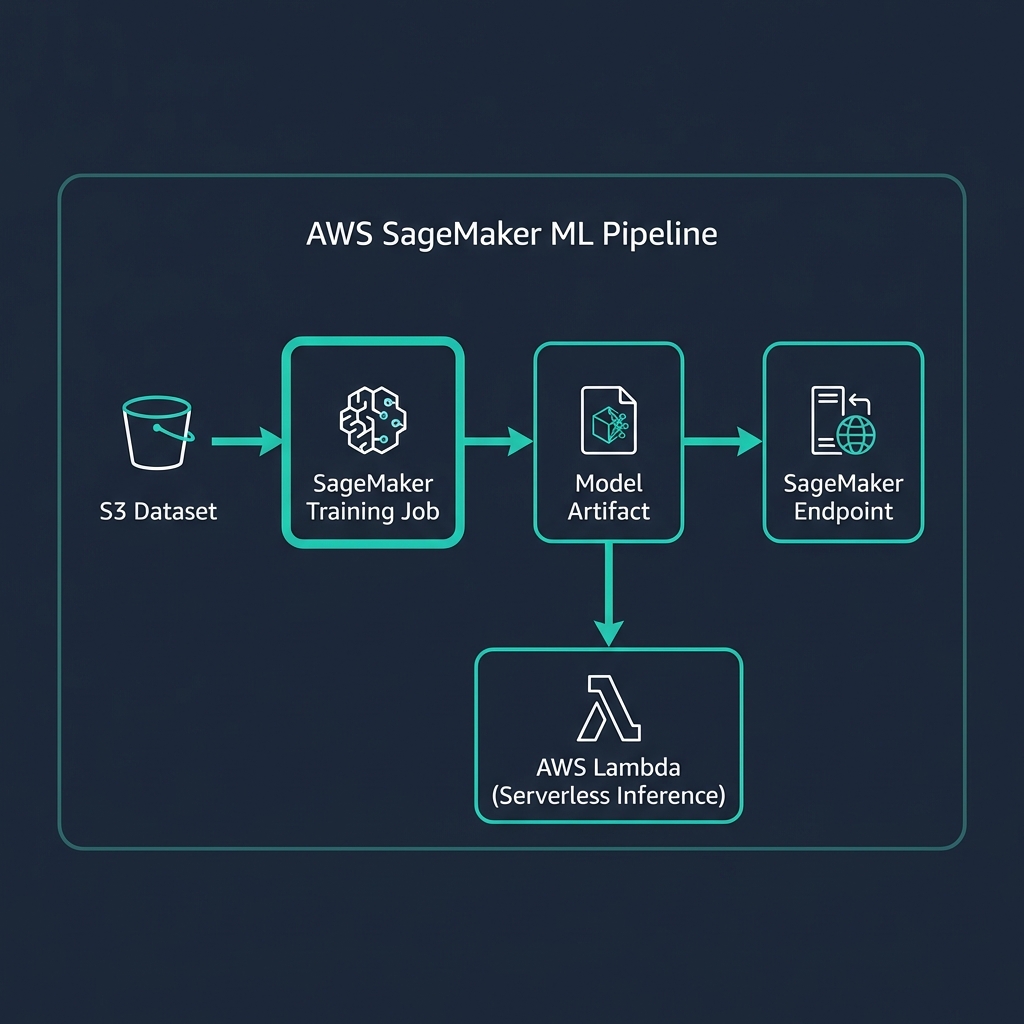
Key Technologies
| Component | Technology | Purpose |
|---|---|---|
| Model | DistilBERT | Lightweight transformer for text classification |
| Dataset | News Aggregator (UCI) | News headlines with four categories |
| Training | SageMaker Training Job | Managed distributed training |
| Serving | SageMaker Endpoint | Real-time inference with auto-scaling |
| Inference | AWS Lambda | Serverless request handling |
| Libraries | Hugging Face Transformers | Model implementation and tokenization |
Project Workflow
Phase 1: Exploratory Data Analysis
Before training, we conduct thorough EDA to understand the dataset characteristics, class distribution, and text patterns.
Loading notebook...
Phase 2: Model Training
We fine-tune DistilBERT on the news classification task using Hugging Face’s Trainer API integrated with SageMaker.
Loading notebook...
Phase 3: Deployment and inference
The trained model is deployed to a SageMaker endpoint with Lambda integration for scalable serverless inference.
Loading notebook...
Lambda Inference Handler
The serverless inference is handled by an AWS Lambda function that invokes the SageMaker endpoint:
import boto3
import json

runtime = boto3.client("sagemaker-runtime")
ENDPOINT_NAME = "multiclass-text-classification-endpoint"

def lambda_handler(event, context):
    payload = json.loads(event["body"])

    response = runtime.invoke_endpoint(
        EndpointName=ENDPOINT_NAME,
        ContentType="application/json",
# Deployment code snippet
predictor = huggingface_model.deploy(
    initial_instance_count = 1,
    instance_type = "ml.m5.xlarge",
    endpoint_name = "multiclass-text-classification-endpoint-final-v1"
)
Product value and limits
The product value is the complete handoff from model artifact to application request. SageMaker provides managed training and serving boundaries, while Lambda provides a small request adapter. This makes the deployment path inspectable and gives a team clear places to add authentication, validation, logging, and cost controls.
The notebooks do not establish production reliability, endpoint economics, or model performance outside the documented dataset and evaluation.
Key Learnings
-
SageMaker + Hugging Face Integration: The
HuggingFaceestimator simplifies training transformer models on managed infrastructure. -
Endpoint scaling: Managed endpoints provide a place to study deployment and scaling configuration; cost behavior still depends on traffic and service settings.
-
Serverless architecture: Lambda can act as a request boundary for a SageMaker endpoint. Production suitability requires separate security, load, and failure testing.
-
Model choice: DistilBERT is used as a smaller transformer option. Any performance or cost comparison must be measured for the target workload.